Frontend and AI ·
OpenAI's generative UI is design-system work
OpenAI's Intelligent UI builds answers from a library of streamable components and a streaming compiler. Why that makes generative UI a design-system job.
OpenAI's 7 October launch, GPT-6 and Intelligent UI for everyone, lets ChatGPT answer with an interface. You can ask it for a calculator to explore how savings grow, a bill splitter for dinner with friends, or a small game. For frontend developers, the interesting part is how it is built.
Components plus a streaming compiler
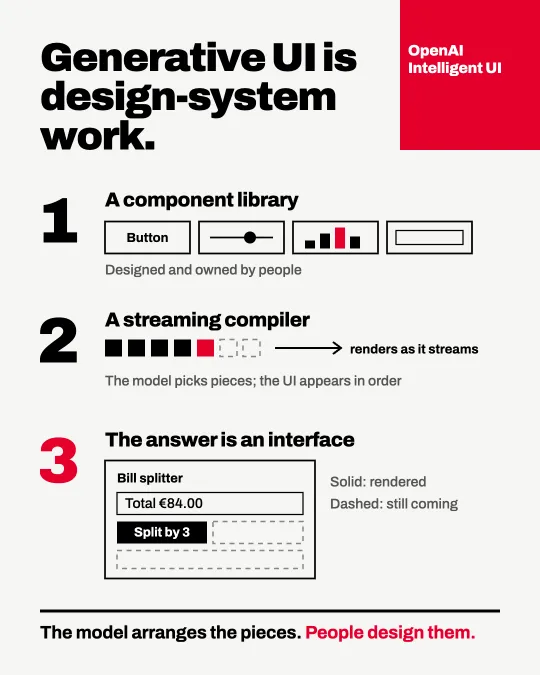
OpenAI describes two pieces: "a library of native, streamable components, along with a compiler that processes the interface as the model generates it." The library gives every response a familiar design foundation while the model decides how the pieces fit together. The compiler lets the interface appear progressively instead of after the whole response.
Why that is our job
The model does not invent the button, the slider or the chart. Someone designed those components, decided what inputs they take and made them work on web and mobile. The model arranges them. That is design-system work: a small set of components with clear inputs, shared tokens and states that hold up when they are combined in ways nobody tested by hand.
Streaming adds a constraint every frontend developer knows from skeleton screens: a component has to look sensible while its data is still arriving. In Angular terms, that means standalone components with typed signal inputs and explicit loading states, the kind of library a generator could compose safely.
Sources
I post short notes like this on LinkedIn.
Need help with this?